domingo, 5 de julio de 2015

Gran Diccionario Oxford 3ra. Edición


El Gran Diccionario Oxford (GDO) en CD-ROM es una poderosa herramienta de sencillo manejo, de renombre mundial. Este nuevo CD-ROM es una fuente de referencia sin igual para traductores, maestros, estudiantes y hombres y mujeres de negocios. Permite acceder al texto de diversas maneras, ofreciendo opciones que no son posibles con el libro impreso:


Consultar palabras desde el navegador de Web, o desde cualquier aplicación de Windows que utilice texto escrito, con solo pulsar un botón del ratón, gracias al revolucionario dispositivo de Búsqueda Instantánea.


Buscar todas las apariciones de una palabra o frase.


Cambiar al otro idioma del diccionario instantáneamente, simplemente haciendo clic en la traducción de una entrada.


Escuchar la pronunciación grabada de la mayoría de los vocablos ingleses.


Utilizar comodines y operadores booleanos.


Copiar y pegar texto en documentos e imprimir las entradas. 


Contraseña: ninguna

Fuente:

Breve curso de pronunciación


A continuación unos videos muy interesantes sobre aspectos fonéticos de inglés, desarrollados en breves lecciones, extraídos de http://funeasyenglish.com.
Pronunciation Lessons - Vowels

These are all of the Fun Easy English vowel pronunciation lessons.
Lesson 1 - pronounce heel, key, piece, seat
Lesson 2 - pronounce eight, mail, pay, taste
Lesson 3 - pronounce food, shoe, to, true
Lesson 4 - pronounce coat, grow, toe, woke
Lesson 5 - pronounce calm, hot, on, spa
Lesson 6 - pronounce building, busy, sit, women
Lesson 7 - pronounce friend, head, said, tell
Lesson 8 - pronounce hat, jam, pan, ran
Lesson 9 - pronounce book, could, full, woman
Lesson 10 - pronounce bought, cost, lawn, walk
Lesson 11 - pronounce fun, couple, money, does
Lesson 12 - pronounce time, type, pie, height
Lesson 13 - pronounce mountain, now
Lesson 14 - pronounce toy, royal, coin, point
Lesson 15 - pronounce near, year, beer, here
Lesson 16 - pronounce hair, wear, stare, there
Lesson 17 - pronounce are, barn, party, star
Lesson 18 - pronounce poor, tour, your, sure
Lesson 19 - pronounce port, pour, door, more
Lesson 20 - pronounce were, bird, turn, learn

 Pronunciation Lessons - Consonants

These are all of the Fun Easy English consonant pronunciation lessons.
Lesson 21 - pronounce pet, putt, pit, peach
Lesson 22 - pronounce bet, but, bit, beach
Lesson 23 - pronounce ten, tip, time, tile
Lesson 24 - pronounce den, dip, dime, dial
Lesson 25 - pronounce cot, coat, came, cave
Lesson 26 - pronounce got, goat, game, gave
Lesson 27 - pronounce front, fast, fan, ferry
Lesson 28 - pronounce vine, vast, van, very
Lesson 29 - pronounce think, method, month
Lesson 30 - pronounce this, these, together
Lesson 31 - pronounce sip, sit, seat, seem
Lesson 32 - pronounce zoo, lazy, noise, please
Lesson 33 - pronounce sheet, machine, station
Lesson 34 - pronounce casual, garage, beige
Lesson 35 - pronounce chance, beach, nature
Lesson 36 - pronounce jungle, jewelry, gem
Lesson 37 - pronounce man, home, time, warm
Lesson 38 - pronounce no, month, honey, ran
Lesson 39 - pronounce singer, spring, ring
Lesson 40 - pronounce road, read, write, for
Lesson 41 - pronounce load, lead, table, special
Lesson 42 - pronounce yard, year, yield, yen
Lesson 43 - pronounce white, word, would, wool
Lesson 44 - pronounce home, hen, hot, happy


Forma irregular del plural


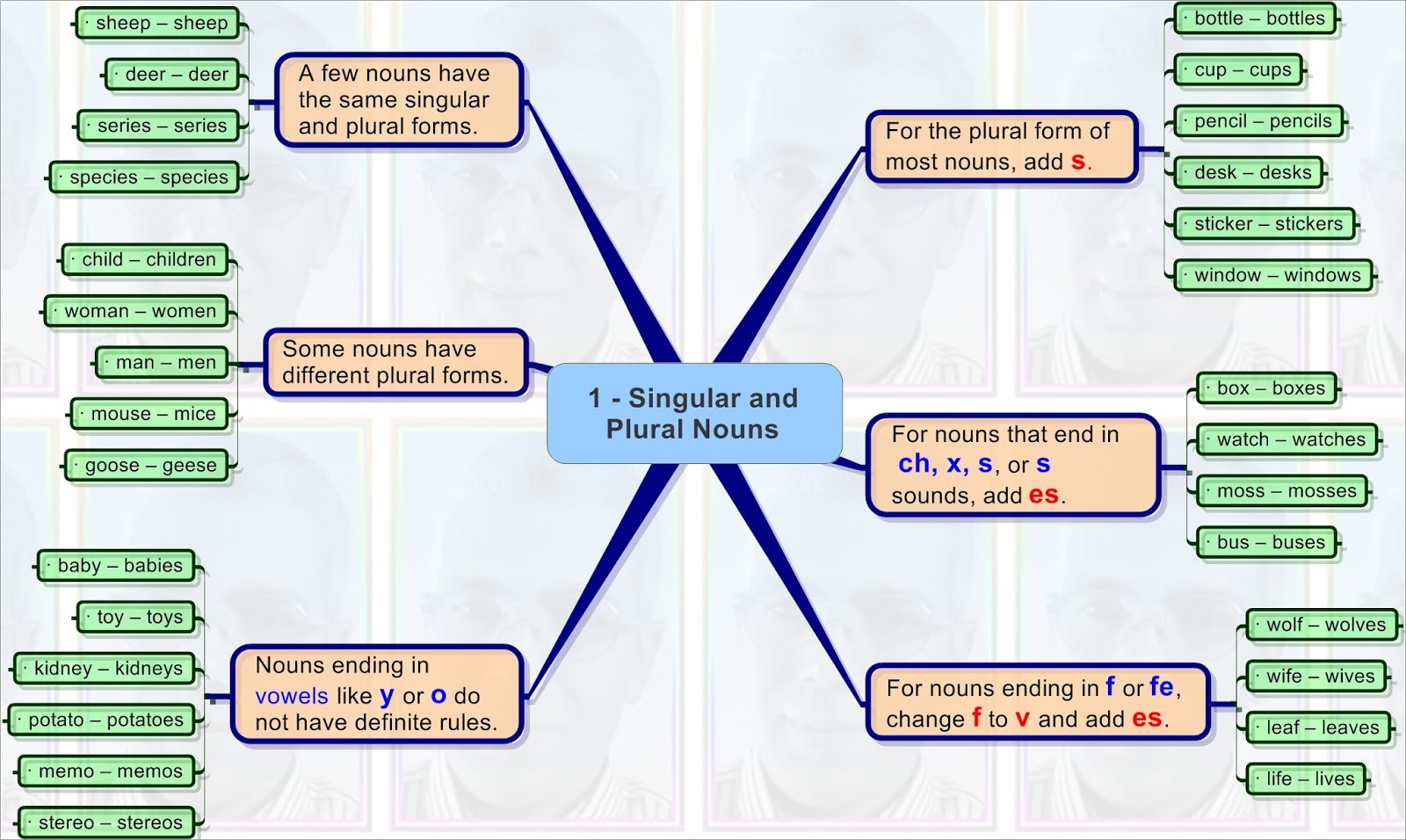
There are some nouns that form the plurals differently. 


 Some nouns change their vowels in the middle of the singular form when forming the plural  

 one goose goose -----> two geese 
 foot - feet 
 louse - lice 
 man - men 
 mouse - mice 
 tooth - teeth
woman - women 

Compounds of words man and woman form plurals the same way: 
 mailman - mailmen 

Words that contain the syllable "man" such as in the word human form the plural by adding the letter s as with most plurals. 

 Several nouns form the plural by adding the letters en: 


 child - children 
 ox - oxen 

 Some words with descriptive adjectives and hyphens form the plural by adding the correct affix to the noun portion of the word. 


 father-in-law - fathers-in law 
 mother-in-law - mothers-in-law 
 brother-in-law - brothers-in-law 
 sister-in-law - sisters-in-law 
 attorney-general - attorneys-general 
 secretary-general - secretaries general 


 There are a number of animals that have the same singular and plural form: 


 bison - bison 
 deer - deer 
 moose - moose 
 sheep - sheep 
 swine - swine 

There are also some animal names that form the plural the same as the singular or use the s or es form:

 antelope - antelope or antelopes 
 cod - cod or cods 
 elk - elk or elks 
 fish - fish or fishes 
 flounder - flounder or flounders 
 grouse - grouse or grouses 
 herring - herring or herrings 
 quail - quail or quails 
 reindeer - reindeer or reindeers 
 salmon - salmon or salmons 
 shrimp - shrimp or  shrimps 
 trout - trout or trouts


Nouns that end in ch, sh, s, ss, x, z, zz form the plural form by adding es

There are several different rules for singular nouns ending in the letters f, fe or ff when changing them to the plural form.


Most nouns ending in the letters f, fe or ff form the plural by adding the letter s.

Some nouns that end in f, fe or ff form the plural by changing the final f form to ves.

Some other words that change the ending to ves in the plural form include:

calf - calves
elf - elves
half - halves
knife - knives
life - lives
loaf - loaves

self - selves (ourselves, yourselves, themselves)

shelf - shelves
thief - thieves
wife - wives

Some others have two forms of the plural:

dwarf - dwarfs or dwarves
hoof - hoofs or hooves
scarf - scarfs or scarves
staff - staffs or staves
wharf - wharfs or wharves


Most nouns that end in i form the plural by adding the letter s.

ski-skis

Others that add the letter s include:

alibi-alibis
khaki-khakis
rabbi-rabbis

Some nouns ending with the letter i form the plural both by adding s and/or es

taxi-taxis-taxies
alkali-alkalis-alkalies
chili-chilies

Nouns ending in the letter o preceded by a vowel form the plural by adding the letter s.

one radio
two radios


Most nouns ending with the letter o preceded by a consonant add the letter s to form the plural

one piano
two pianos


Some nouns ending in the letter o preceded by a consonant add es to form the plural

one potato
two potatoes
Others that add es include:

echo - echoes
hero - heroes
jingo - jingoes
no - noes
tomato - tomatoes


If a singular noun ends in y and is preceded by a consonant, the y is changed to i and es is added.

butterfly - y + i + es = butterflies

1 butterfly
2 butterflies

If a singular noun ends in y and is preceded by a vowel, the letter s is simply added with no other changes made.

monkey + s = monkeys

Some nouns ending with the letter o preceded by a consonant can form the plural two ways

one zero
two zeros - zeroes


Others that form the plural with both s and es include:

buffalo - buffalos or buffaloes
cargo - cargos or cargoes
desperado - desperados or desperadoes
halo - halos or haloes

mosquito - mosquitos or mosquitoes


Fuente:

Los nombres


Los nombres pueden referirse a cosas que pueden o no ser cuantificadas. 


Fonética


Just like the -ed ending, there are three ways of saying the plural “s” ending in English:
[s]
[z]
[ɪz]
Example

When we say the plural of two basic words in English:

  1. “cats” [kæts]
  2. “dogs” [dawgz]

the plural “s” is said in two different ways:

  1. “cats” [kæts] with an [s].
  2. “cats” [kæts]
  3. “dogs” [dawgz] with a [z].
  4. “dogs” [dawgz]


Why does the sound of the plural “s” change?

The goal for English speakers is to speak efficiently, to say the most they can in the shortest amount of time. When there is a change in sound, the change is often caused by the sound right before it. This allows the vocal chords in particular to be more efficient; to continue what they are doing.
Practice and Understand

[t]

Put your hand on the front of your neck and say the sound [t]. What do you feel?
You should feel nothing at all, meaning, there is no vibration in the vocal chords when you say [t].

[d]

Now, put your hand on the front of your neck and say the sound [d]. What do you feel?
You should feel a vibration now. That’s because the vocal chords vibrate when you say the sound [d].
*This vibration or lack of vibration is what causes the plural “s” to sound like a [s] or [z].

[s]

Now, put your hand in front of your neck and say the [s] sound. What do you feel? You should feel no vibration.

[z]

Put your fingers on the front of your neck and say the [z] sound. What do you feel? You should feel the vibration of the vocal chords.

Rule


  • Any time a word has a sound just before the plural “s” that has NO vibration in the vocal chords, the plural “s” will continue the lack of vibration and sound like a [s].
  • Any time you have a sound before the plural “s” that has the vibration, the vibration will carry forward and transform the letter “s” into the [z] sound.
  • There are also some sounds that require an extra syllable in order to be articulated.

Example

I can’t even say the plural of “bridge” without adding an extra [ɪ] sound before the plural “s”. So we add the extra syllable to say:
“bridges” [brɪdʒ ɪz]
[s]
Voiceless sounds that cause the plural “s” to be pronounced as [s] include:
[p], [t], [k], [f]


Example

weeks [wiyks]
bits [bɪts]
backs [bæks]
briefs [briyfs]

[z]
Voiced sounds that cause the plural “s” to be pronounced as [z] include:
[b], [d], [g], [l], [r], [w], [m], [n], [v], [y]


Example

webs [wɛbz]
beds [bɛdz]
bags [bægz]
bells [bɛlz]
jars [jɑrz]
canoes [kəNUWZ]  | (note the [uw] vowel sound ends in a [w])
straws [stʃrɑwz]
limbs [lɪmz]
fans [fænz]
doves [dʌvz]
delays [dəLeYZ]

[ɪz]
The sounds that cause the plural “s” to be pronounced with an additional syllable [ɪz] include:
[tʃ] [dʒ] [s] [z]


Example

watches  [WA tʃɪz]
bridges  [BRɪ dʒɪz]
judges  [dʒʌ dʒɪz]
slices [SlAiY sɪz]
blazes [BLeY zɪz]

Note


The sound of the plural [s] can be important to pronounce accurately if it affects your being clearly understood.

Listen and Repeat

Notice how I connect the plural “s” to the word that follows, and how I de-stress the function words, such as transforming the “of” into [ə], to create linking and music in my speech.

“The dogs are eating at twelve.”
“There are bits of cake on the floor.”
“Judges always wear black in court.”
“The slices of pizza got cold.”
“Please put the three bags in the hallway.”
“The delays at the airport weren’t so bad.”
“We are big fans of that type of music.”
“How many weeks until your trip?”


Fuente:

Algunas consideraciones fonéticas


La fonética inglesa es producto de la fonología en inglés. La fonología es el estudio del sistema de sonido de un lenguaje en particular. Como en muchos idiomas, el inglés varía en pronunciación, de forma tanto histórica como de dialecto a dialecto. En general, de todos modos, los dialectos regionales más importantes del habla inglesa son inteligibles entre ellos.

Aunque hay muchos dialectos diferentes del inglés, los siguientes son utilizados como acentos estándar o de prestigio: Pronunciación Recibida para el Reino Unido, Americano en General para los Estados Unidos y Australiano en General para Australia.

Fonética Articulatoria: describe cómo las vocales y consonantes son producidas o “articuladas” en las diferentes partes de la boca y garganta.
Fonética Acústica: Cómo los sonidos son transmitidos. Cuando el sonido viaja a través del aire desde la boca del hablante hasta la oreja del oyente lo hace mediante vibraciones en el ambiente.
Fonética Auditiva: Cómo percibimos los sonidos. Da una mirada hacia el modo en que el cerebro del oyente decodifica las ondas de sonido nuevamente hacia las vocales y consonantes que el hablante quiso expresar.

El sonido que está siendo producido, sea una simple vocal o consonante se llama fono.

La fonología sostiene que el lenguaje hablado puede ser desmenuzado en una serie de unidades de sonido llamadas fonemas. Un fonema es la unidad distintiva de sonido más pequeña de un lenguaje en particular. Distingue una palabra de otra en un lenguaje determinado. Aunque esto signifique cambiar un fonema en una palabra, este cambio produce otra palabra con otro significado. Es así como en inglés tenemos las palabras “pat” y “rat”, los sonidos distintivos /p/ y /r/ son ambos fonemas. El fonema es un término abstracto y es específico de un lenguaje en particular.

Un fonema puede tener varios alófonos, que son sonidos relacionados que son distintos pero no cambian el significado de una palabra cuando son intercambiados. Los sonidos correspondientes a la letra “t” en las palabras inglesas “two” y “trick” no son de hecho los mismos. La posición de la lengua al nombrarlos es diferente, lo que causa una percepción en el sonido detectable por un instrumento tal como un espectógrafo del habla. Es así como la t en “two” y la t en “trick” son alófonos del fonema /t/.

Los sonidos de las vocales


La clasificación de las vocales está basada en cuatro aspectos importantes:
  1. La altura en donde se encuentre la lengua: acorde a la posición vertical de la lengua (se dividen en vocales altas o cercanas, vocales bajas o abiertas, o intermedias)
  2. Si la lengua está al frente o atrás: acorde a la posición horizontal de la parte superior de la lengua.
  3. Redondez de los labios: ya sea cuando los labios están redondeados (con forma de O) o abiertos (sin estar redondos) cuando el sonido está siendo realizado.
  4. La tensión de los articuladores: se refiere a la cantidad de tensión muscular alrededor de la boca cuando se crean sonidos de vocales. Las palabras “tense” y “lax” son utilizadas en inglés para describir tensión muscular.


Vocales del frente(la lengua está hacia adelante) Vocales centrales(la lengua está neutral) Vocales posteriores(la lengua está hacia atrás)
Vocales cercanas (la lengua está levantada) wee, pit loot, took
Vocales intermedias(la lengua está en una posición intermedia) wait, let tofu, birch coat, thought
Vocales abiertas(la lengua está baja) rat under father, cock
En algunos acentos americanos (como el Inglés Californiano), los sonidos de vocal en palabras así como trait, late, vane y coat, boat, tote no son considerados como diptongos. Los fonólogos americanos usualmente los califican como monoptongos tensos (/e/ y /o/).

Los sonidos de las consonantes

Acorde a la manera de articularlas (como se utiliza la respiración), las consonantes pueden ser divididas en:


Oclusivas
Durante la producción de estos sonidos, el aire de los pulmones es completamente bloqueado y luego liberado
En inglés, estas consonantes son /p/, /b/, /t/, /d/, /k/, y /g/
Fricativas El flujo de aire es constreñido, pero no totalmente bloqueado o detenido
En inglés, estas consonantes incluyen /f/, /v/, /s/, /z/, y /h/
Africadas Estos sonidos comienzan como los oclusivos, con un completo bloqueo del aire del tracto vocal, y concluyen con un flujo de aire restringido como los fricativos
En inglés hay dos sonidos africados: la /tƒ / que se puede encontrar en la palabra “church” y la /dz / de “judge”
Nasales Los sonidos nasales son aquellos realizados gracias a que el aire pasa a través de la nariz.
En inglés, estas consonantes son /m/, /n/, y / /
Laterales Las consonantes laterales permiten que el aire escape a los lados de la lengua
En inglés hay sólo una consonante con ese sonido: /l/
Aproximantes Para realizar un sonido aproximante, un articulador tiene que estar cercano a otro, pero el tracto vocal no es tan estrecho al punto en que una ráfaga de aire turbulenta pueda llegar a producirse
En ingles, estas consonantes son /j/, /w/ y /r/. A los aproximantes /j/ y /w/ también se los llama semi- vocales

Según donde se produce la articulación (boca o garganta)


Bilabial, con ambos labios /p/, /b/, /m/
Labiodental, entre el labio inferior y los dientes superiores /f/, /v/
Dental/ Interdental, entre los dientes /ð /
Alveolar, el espacio detrás de los dientes frontales superiores /t/, /d/, /s/, /z/, /n/, /l/, /r/
Alveo-palatal (o post-alveolar), es el área entre el espacio alveolar y el paladar duro /tƒ/
Palatal, paladar duro /j/
Velar, paladar blando (o velo) /k/, /g/
Laringial, espacio entre las cuerdas vocales /h/

Fuente: